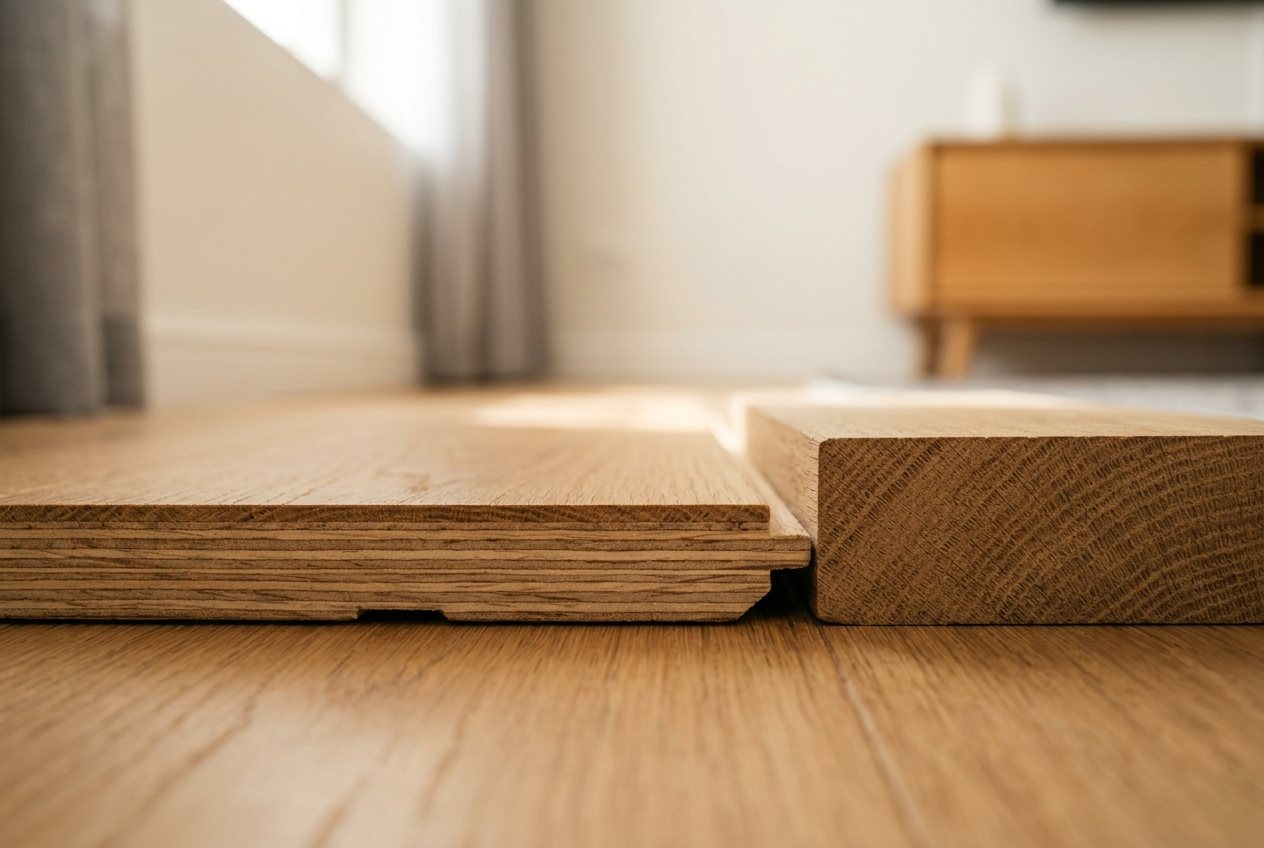
Both are real wood. Both can be sanded and refinished. But in a climate like Cape Town’s, coastal air, wet winters, dry summers and plenty of underfloor heating going in, the way each is built matters more than most people realise.
The difference in one line
Solid wood is a single piece of timber, milled from top to bottom. Engineered wood is a real timber veneer (typically 3–6 mm of oak) bonded onto a stable multi-ply core. You walk on real wood either way, the difference is what sits underneath.
Why the core matters in the Cape
Wood moves with moisture and temperature: it swells when humid, shrinks when dry. A solid plank does this across its full width, which is what causes cupping, gapping and creaking when conditions swing. Engineered wood’s cross-layered ply core holds it far more stable, so it copes much better with the humidity changes you get near the coast and with the dry heat of underfloor heating.
How they compare
| Engineered wood | Solid wood | |
|---|---|---|
| Make-up | Real oak veneer on ply core | Single piece of timber |
| Stability | Excellent: resists movement | Moves more with humidity |
| Underfloor heating | Suitable | Usually not recommended |
| Board widths | Wide planks available | Narrower to stay stable |
| Installation | Floating or glued | Nailed/glued to a sound base |
| Re-sanding | 2–4 times (depends on veneer) | Several times |
Does the veneer thickness matter?
Yes: it is effectively the wood’s wear layer. A 14/3 mm board has a 3 mm oak top that can be sanded two to three times; a 15/4 mm board sands three to four times. Thicker veneer, more life. Our FINOak Atelier and Oggie and Como engineered ranges span 14/3 up to 20/6 mm.
When solid wood still makes sense
Solid timber is a beautiful choice for a period home, an upstairs room with a timber subfloor, or where a client specifically wants a traditional nailed-down floor and understands the maintenance. It is not that solid wood is bad, it is that engineered gives most people the same look with fewer worries.
Pre-finished or raw?
Engineered comes pre-finished (factory-sealed, ready to lay) or unfinished (sanded, stained and sealed on site for a fully bespoke colour). If you want a specific tone or a dead-matte oiled look, unfinished plus our sand & seal service gives you total control.
Ready to compare boards? Browse the engineered wood range, work out your area, and request a free quote.
Frequently asked questions
Is engineered wood real wood?
Yes. The top layer is a solid timber veneer, usually 3-6 mm of real oak, bonded to a stable plywood core. You see and walk on genuine wood; the engineered core simply makes the board more stable than solid timber.
Is engineered wood better than solid wood for Cape Town?
For most Cape Town homes, yes. The coastal humidity swings and dry summers cause solid wood to cup, gap and creak more, while engineered wood's cross-layered core stays far more stable. Engineered is also suitable for underfloor heating, where solid usually is not.
Can engineered wood be sanded and refinished?
Yes, depending on the veneer thickness. A 3 mm veneer can typically be sanded two to three times and a 4 mm veneer three to four times over its life, which is enough for decades of use in a home.
Can you lay engineered wood over underfloor heating?
Engineered wood is generally suitable for underfloor heating because of its stable core, provided the system is installed and commissioned correctly. Solid wood is usually not recommended. We advise on the right board and installation method for heated floors.
Not sure which floor is right for your space?
Send us your rooms and we’ll recommend the right product and give you a clear, free quote, supply-only or fully installed.
Get a Free Quote ↗